Sunday, November 21, 2010

Fear Sells

As we discussed Act 3 of The Crucible in class this week, the notion that "fear sells" was brought up. I mean we've all heard that sex sells, but can fear really be used to make consumers buy a certain product?

There is a great article on companies using fear as a tool to persuade consumers into buying their product. Click here to read. In it, the author talks of how Broadview Security airs ads "that feature a series of scenarios that play on women's darkest fears." Like some guy a woman met at a party breaking into her house only a couple of hours later. Obviously the commercial is used to show how effective Broadview Security is, but it also strikes a sense of panic in the women viewers. Many of the other Broadview ads follow the same pattern. A woman is alone and defenseless when a someone tries to break into her home, only to be stopped by the Broadview alarm.

Here is some of their commercials:
http://www.youtube.com/watch?v=MeBt2xouWbY

http://www.youtube.com/watch?v=syjM1dPriBA&feature=related


Martin Lindstrom, who wrote Buyology: Truth and Lies About What We Buy and other marketing books, is quoted in the article. He addresses why fear is used in advertising when he says,

"There's actually a neurological reason for why fear is becoming increasingly effective advertising tool, says Lindstrom, who studied the brain scans of more than 2,000 people as they were shown marketing and advertising strategies. The amygdala, the part of the brain that generates fear, kicks in when a person's under stress, and tends to stay alert and receptive to fear signals until the danger goes away, he says. And in today's environment, with consumers concerned with everything from terrorism to the environment, there are increasing number of fear signals pushing consumers' buttons."

He also adds,

"The consequence of guilt and fear is that we buy more to compensate. The security companies are plugging into that."

Broadview Security had reaped the benefits of this advertising campaign. Revenue has increased 7.5% and sales increased 6.2%. Their overall net income has jumped 9.8%.

I think fear can be used to make consumers buy a product and that its been proven to be very successful. There are high levels of fear through the country already with the economic recession, terrorism, the obesity epidemic, etc. So fear has become an effective tool for advertisers and companies. However, I'm not sure if it's right to play with people's fears like that.


Sunday, November 14, 2010

Sink Your Teeth Into This

As we started The Crucible in class, Mr. O'Connor mentioned how mythological creatures became popular because of something that was occurring in society. I immediately began thinking about the vampire phenomena that seems to be sweeping over the world. With movies like Twilight, TV shows like True Blood and the Vampire Diaries, and novels like the Vampire
Academy series (and Twilight of course), vampires seem to be everywhere. So why are we so obsessed with these bloodsucking creatures?
One theory is because of the AIDS epidemic. In an interview, writer Neil Gaiman addressed this claim by saying, "
I think then the thing that changed everything and that gave vampire fiction a new lease on life and death was AIDS, because you hit the early ‘80s, and suddenly you have something in the blood that is an exchange of blood that kills and is altogether fundamentally about sex. And vampirism essentially came out of the closet as a metaphor for the act of love that kills. "

Gaiman brings up a very interesting point. So if AIDS is what created a vampire hysteria in the 80s and 90s, is it still responsible for the rebirth of the vampire obsession?

I don't believe so. I do think that AIDS originally created this whole infatuation with these deadly creatures, but I don't think it's what's fueling the attraction these days. I think vampires are outsiders, and it's something many people can relate to.

Gaiman touches on this notion when he said, "I don’t think vampirism, at least from my point of view, is ever about power, because it’s always about people exiled to the fringes. Vampires, I think, should be outsiders."

I completely agree with the idea that it's about people being "exiled" or even ostracized; however, I disagree with him in the fact that he doesn't think vampirism is about power. I do think it is. I think it's about having complete control over another person. Otherwise, why else would they give vampires mind reading powers or hypnotizing gazes? People fantasize about being in control and vampires assist that fantasy.

Sunday, November 7, 2010

A Modern Day Witch-hunt

As we begin reading The Crucible, a play about the Salem witch trails in Massachusetts Bay Colony during 1692-1693, I remembered a person we discussed also in class a couple weeks back. Julian Assange, the creator of WikiLeaks, has been hunted as he recently released 391,832 confidential documents of the Iraqi war. Here is an article from the New York Times which tells of his notoriety.
Julian Assange

According to the article, Assange "demands that his dwindling number of loyalists use expensive encrypted cellphones and swaps his own the way other men change shirts. He checks into hotels under false names, dyes his hair, sleeps on sofas and floors, and uses cash instead of credit cards, often borrowed from friends."

He has even referred to himself as the "James Bond of journalism." And he basically is one, by changing phones every day and having multiple aliases. He fears Western intelligence agencies who hunt him. He's risking being jailed for life or even executed to put out this information. The government has demanded that he return all US documents in his possession and no longer search for any more. Here are some of his chilling accounts of the Iraq war.

"'I’ve been waiting 40 years for someone to disclose information on a scale that might really make a difference,' said Daniel Ellsberg, who exposed a 1,000-page secret study of the Vietnam War in 1971 that became known as the Pentagon Papers. "

But even throughout all the chaos and consequences Assange has to face, is he doing the right thing? Should the public know the truth? Even if the way the truth was discovered was illegal?

I do believe the public deserves to know the truth, but the government should be supplying it, not hacking organizations. We shouldn't have to find out what's going on in Iraq through leaked documents. We should be given those documents. I understand that the government is trying to protect us, but we cannot live in ignorance. Especially, when the people we elect and support are committing things that are against our beliefs. And even more importantly, when we are affected severely by it.

I find it interesting that even though Assange is shedding light to what is going on over seas, some of his colleagues call him "erratic" and "imperious." Do you think Assange's practices are okay? Do you support them? Or do you believe he's taken it too far?

Monday, November 1, 2010

The Truth Behind Subliminal Advertising

An image of the McDonald's logo captured during an episode of Iron Chef on the Food Network.

Today in class we discussed how people can interpret advertising slogans in different ways. I earlier made a post about companies use certain colors in their advertisements to attract customers. But now I started to wonder about subliminal advertising. Subliminal advertising is when hidden messages are embedded within ads.

Back in the 70s, people became fearful that the subliminal messages in ads could be used to brainwash themselves. So the Federal Communications Commission (FCC) banned the use of subliminal messages in advertisements, regarding it as a deceptive business practice.

However, forms of subliminal advertising still exist today. Like for example, when you're watching a movie and the characters are in the city, where in the background, coincidentally of course, are billboards with large ads. Another example, could also be product placing in movies. Like in this ad for the movie the Italian Job,
Notice the Mini Cooper. How necessary is that in this ad? True, there are car chases in the movie with the Mini Coop, but that's not essentially what the movie's about. The ad could easily make do without the addition of the Mini Cooper, yet, does it choose to incorporate it for a specific reason?

In an article by the New York Times (click here to read) , they state,

"Lest you doubt these brand placements influence young eating habits, the appearance of Reese’s Pieces in the movie “E.T. the Extra-Terrestrial” resulted in a sharp increase in sales in the three months after the movie’s release in 1982.'Movie product placement is on a par with subliminal advertising.'"

Furthermore, they write,

"The authors, led by Lisa A. Sutherland of Dartmouth Medical Center, found an average of 8.6 brand placements per movie, and concluded that most were 'for energy-dense, nutrient-poor foods or product lines.'"

Not only are products being snuck into movies, but they're promoting unhealthy eating habits, especially for children.
Another example of a form of subliminal advertising is a new Chipotle ad that came out this summer.

Obviously, Chipotle tastes delicious is in bold, bringing the consumer's eye to that. Never once do they mention if their meat is actually raised without hormones. But by the end of the ad, you don't even care. All you know is CHIPOTLE TASTES DELICIOUS.

As consumers, we have to be aware of what we are buying for the sake of our health and safety. It's interesting how many different advertisements are being thrown at us every day, that we aren't even aware of. The public bus, the internet, the tv commerical. We are constantly being told what to buy. I think companies use sneaky tactics in order to raise products, and in order for us to be intelligent consumers, we have to know how big of an impact it has on us.


Monday, October 25, 2010

A META-POST

First, I would like Mr. O'Connor and Mr. Bolos to assess my "Into the Wild: The Sean Penn Version" post.
As I reread my posts, I honestly have to say they're are some I cringe at and they're are some I'm pretty proud of. I do have to say I feel like my "I Love College?" post was just a filler. I was having a very busy weekend, and I did it just to complete it. I feel like my post didn't have too thought or depth into it, and that kind of bugs me. I really enjoy this blogging assignment because I like having the freedom to say what I think. And it bothers me that I just put a post in there, just to show the teacher I did the homework. I wish I would have gone more in depth, or chosen something more interesting to write about. Although, I do think a lot of people can relate to it. I just don't think my post had enough substance.

However, I am proud of my other posts. I think I've incorporated topics that most people can relate to, whether it's racial supremacy in a sport or the reasons why people lie. I do notice a theme of race in my posts, but I account that to what we have been discussing in class. I think our class discussions inspire me to dig deeper into this sensitive topic and see how it affects our society today, such as how we view colors or examples of racism still existing today.

I do notice that in my later posts I have chosen to incorporate more pictures. Well first, I finally figured out how to put the pictures in my posts. But I also think it adds to the message or topic I'm writing about. It gives a visual to the reader and makes it a little easier to understand the post. Now you have something you can see to place with topic.

I think what most surprised me about my posts was how much more evidence I gave than I originally though I did. For example, from my "How Racist are We?" post, I backed up my claim that our society is more racist than we think by providing three examples. One was "
I just want to discuss an article I had read in the New York times. Click here to read. It says that new research discovers 'strong evidence that all-white juries acquit whites more often and are less favorable to black versus white defendants when compared to juries with a least one black member.'" I think it was smart of me to try and find different examples of racism occurring today to back up my argument, instead of just providing one example.

I really do enjoy this weekly blogging. Besides the freedom, I like being able to incorporate things I learned in class to events happening in the world today. It makes the learning more real and substantial. I hope my posts convey that.

Sunday, October 17, 2010

The Connotations of Color


We've been talking a lot about race in AS lately, and it got me thinking about how colors in general affect society. Every single color has its own connotation. White is associated with purity and cleanliness. It contains every color in the spectrum. Red can be anger or excitement or even love and romance. Green is the color of growth, nature, and money. It can symbolize harmony, or even jealously and greed. Blue symbolizes calmness and wisdom. Ask people and many would say that its their favorite color. While black is often noted as a sign of power or authority, and sometimes even evil. In the Western part of the world, it is the sign of mourning.

Colors are everywhere, and many companies use specific colors in their marketing because they believe it will attract certain types of customers. Color plays a key r
ole in the success of advertising. Look at McDonald's. The two colors of their logo are a bright red and warm yellow. The bright red has the ability to appear closer than it truly is and grabs the customer's attention first. Then the warm yellow activates considerations of food, warmth, shelter, and physical comfort, encouraging the customer to come in and eat.
So if colors have the power to make you stop in and have a burger, can they influence how you view others? If the color white symbolizes purity and goodness, does that mean that all white people are good and pure? And that those who are not white, simply are not? Colors might affect your mood, but they should not affect your thinking. And I don't believe the connotations of colors should be completely at fault for the inequalities and tension between races. I think it's how society chooses to react to those colors that affects how we interact with each other.

Monday, October 11, 2010

I Love College?

I recently conducted an interview with my journalism teacher Mr. Lucadamo for our AS class. During our interview, Mr. Lucadamo, who is sixty-four years old, began talking about the difference between college mentality when he was a teenager to how it is now. He said, "I went to college thinking this is not to get a job; this is to expand your mind. I ask kids today, 'Why do you want to go to college?' And what do you think their response is? To get a job."

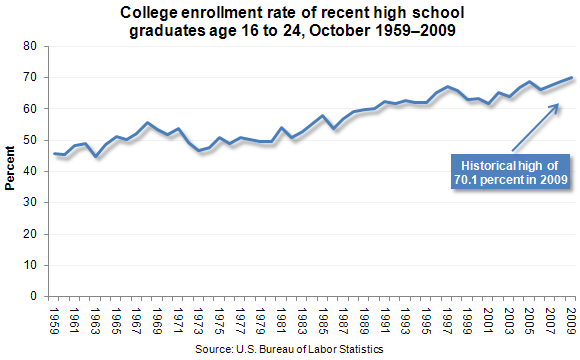
It is believed that in order to get a "good" job today, you need a college degree. Employment rates are down because of the recession, which places more pressure on the new college generation. It has been shown that college enrollment is at a record high, with more than 70 percent of the 2009 high school graduating class enrolling in college in October.

Not only is there higher pressure to attend college, but there is also a greater pressure to attend a top college, especially at New Trier. Kids take the ACT multiple times in order to get their "perfect" score, even if each time they take the test they're only a point away. But here the mentality is that every point matters. Which is crazy. How can we expect to learn and enjoy school when it becomes a competition of who can get the highest score? We're competing, not learning. It's the same reason why kids load themselves up with AP classes and drown under the stress of them. They think it looks good for college, but are they really learning or just struggling to barely stay afloat? This pressure is unhealthy, and it causes unhealthy goals for kids these days.