Monday, October 25, 2010

A META-POST

First, I would like Mr. O'Connor and Mr. Bolos to assess my "Into the Wild: The Sean Penn Version" post.
As I reread my posts, I honestly have to say they're are some I cringe at and they're are some I'm pretty proud of. I do have to say I feel like my "I Love College?" post was just a filler. I was having a very busy weekend, and I did it just to complete it. I feel like my post didn't have too thought or depth into it, and that kind of bugs me. I really enjoy this blogging assignment because I like having the freedom to say what I think. And it bothers me that I just put a post in there, just to show the teacher I did the homework. I wish I would have gone more in depth, or chosen something more interesting to write about. Although, I do think a lot of people can relate to it. I just don't think my post had enough substance.

However, I am proud of my other posts. I think I've incorporated topics that most people can relate to, whether it's racial supremacy in a sport or the reasons why people lie. I do notice a theme of race in my posts, but I account that to what we have been discussing in class. I think our class discussions inspire me to dig deeper into this sensitive topic and see how it affects our society today, such as how we view colors or examples of racism still existing today.

I do notice that in my later posts I have chosen to incorporate more pictures. Well first, I finally figured out how to put the pictures in my posts. But I also think it adds to the message or topic I'm writing about. It gives a visual to the reader and makes it a little easier to understand the post. Now you have something you can see to place with topic.

I think what most surprised me about my posts was how much more evidence I gave than I originally though I did. For example, from my "How Racist are We?" post, I backed up my claim that our society is more racist than we think by providing three examples. One was "
I just want to discuss an article I had read in the New York times. Click here to read. It says that new research discovers 'strong evidence that all-white juries acquit whites more often and are less favorable to black versus white defendants when compared to juries with a least one black member.'" I think it was smart of me to try and find different examples of racism occurring today to back up my argument, instead of just providing one example.

I really do enjoy this weekly blogging. Besides the freedom, I like being able to incorporate things I learned in class to events happening in the world today. It makes the learning more real and substantial. I hope my posts convey that.


Sunday, October 17, 2010

The Connotations of Color


We've been talking a lot about race in AS lately, and it got me thinking about how colors in general affect society. Every single color has its own connotation. White is associated with purity and cleanliness. It contains every color in the spectrum. Red can be anger or excitement or even love and romance. Green is the color of growth, nature, and money. It can symbolize harmony, or even jealously and greed. Blue symbolizes calmness and wisdom. Ask people and many would say that its their favorite color. While black is often noted as a sign of power or authority, and sometimes even evil. In the Western part of the world, it is the sign of mourning.

Colors are everywhere, and many companies use specific colors in their marketing because they believe it will attract certain types of customers. Color plays a key r
ole in the success of advertising. Look at McDonald's. The two colors of their logo are a bright red and warm yellow. The bright red has the ability to appear closer than it truly is and grabs the customer's attention first. Then the warm yellow activates considerations of food, warmth, shelter, and physical comfort, encouraging the customer to come in and eat.
So if colors have the power to make you stop in and have a burger, can they influence how you view others? If the color white symbolizes purity and goodness, does that mean that all white people are good and pure? And that those who are not white, simply are not? Colors might affect your mood, but they should not affect your thinking. And I don't believe the connotations of colors should be completely at fault for the inequalities and tension between races. I think it's how society chooses to react to those colors that affects how we interact with each other.

Monday, October 11, 2010

I Love College?

I recently conducted an interview with my journalism teacher Mr. Lucadamo for our AS class. During our interview, Mr. Lucadamo, who is sixty-four years old, began talking about the difference between college mentality when he was a teenager to how it is now. He said, "I went to college thinking this is not to get a job; this is to expand your mind. I ask kids today, 'Why do you want to go to college?' And what do you think their response is? To get a job."

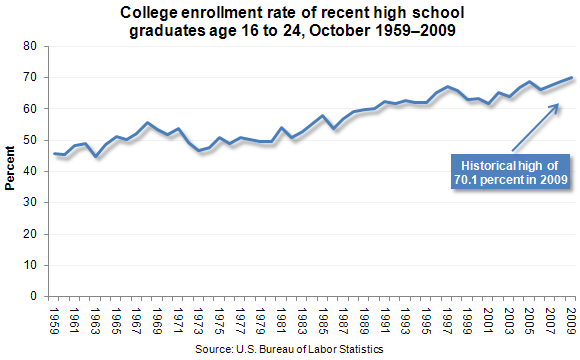
It is believed that in order to get a "good" job today, you need a college degree. Employment rates are down because of the recession, which places more pressure on the new college generation. It has been shown that college enrollment is at a record high, with more than 70 percent of the 2009 high school graduating class enrolling in college in October.

Not only is there higher pressure to attend college, but there is also a greater pressure to attend a top college, especially at New Trier. Kids take the ACT multiple times in order to get their "perfect" score, even if each time they take the test they're only a point away. But here the mentality is that every point matters. Which is crazy. How can we expect to learn and enjoy school when it becomes a competition of who can get the highest score? We're competing, not learning. It's the same reason why kids load themselves up with AP classes and drown under the stress of them. They think it looks good for college, but are they really learning or just struggling to barely stay afloat? This pressure is unhealthy, and it causes unhealthy goals for kids these days.


Sunday, October 3, 2010

White Boys Can't Jump?

Lately in AS, we watched a documentary detailing in the specifics of race and if it was biological or social. In it, they discussed if certain races were dominate in sports because of their genetics. You've heard the rumors. Some races have an extra muscle that helps them run faster or some races can't jump as high as other ones. Well the video states that there has been no discovery of a correlation between race affecting athletic ability.

But if you look at the any of the major sports, it does seem that one race tends to dominate. In the NBA, 82% of the players were African American. In the NFL, 67% of players were also African American. In the MBL, 60% of players were white. And in the NHL, a staggering 95% of all players are white.
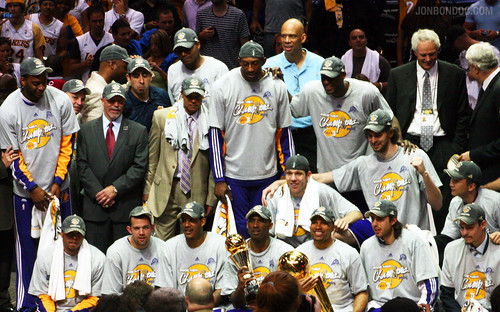
Look at the difference between two championship teams this year, the Chicago Blackhawks and the Los Angeles Lakers.

The difference between races in each sport is not small. In fact, it makes you wonder why are there such huge percentage differentials? If genetics has no factor on a race's athletic ability than why do some races tend to excel at certain sports by an unbelievable margin?

I believe that environment has a lot to do with it. In an interview with Joseph Graves Jr., professor of evolutionary biology, he states that

If we were to look at people from northern climates, who were indigenous residents of northern climates, they tend to be short and stout instead of long or tall and lean. And there are good physical reasons for that. If you evolved in northern climates, like the Aleut or the Eskimo populations did, heat retention is facilitated by being short and stout. If you evolved in the tropics, where the environment is very hot, then heat loss is facilitated by being long and lean. So you're going to see differences in body proportions on that kind of scale.Now, if you were to ask yourself, "Is it likely that an Alaskan Eskimo is going to become a center in the NBA?", well, probably not, because height has something to do with your performance at that position in the NBA.

Obviously in order for someone to be a great basketball player, they would need a good height for the game. There's no way a 5'6 man can hold up against someone is 6'5. I also think another huge component is the way athletes train. Those who take 100 shots a day to improve their free throw percentage would definitely become a better player than those who only took shots at practices.I also have noticed that most runners who are of African ancestry, have trained in other countries than Africa. So that doesn't necessarily mean that Africa truly produced those runners. Maybe the training did.

Graves touches on this when he says,

if you look at those sprinters of Western African ancestry, they all got their records because they trained in the United States, Canada, Great Britain, or even in the Caribbean. If you look at the Western African countries where those sprinters' ancestors supposedly came from, none of those countries have ever produced any world record holders in the sprint events.

So how much of a factor do you think race is?

Sunday, September 26, 2010

How Racist are We?

This week in class we discussed Barrack Obama's speech "A More Perfect Union", when he still was a senator and a presidential candidate hopeful, given in Philadelphia on March 18, 2008. It was a speech about race. In it he states,

Just as black anger often proved counterproductive, so have these white resentments distracted attention from the real culprits of the middle class squeeze - a corporate culture rife with inside dealing, questionable accounting practices, and short-term greed; a Washington dominated by lobbyists and special interests; economic policies that favor the few over the many. And yet, to wish away the resentments of white Americans, to label them as misguided or even racist, without recognizing they are grounded in legitimate concerns - this too widens the racial divide, and blocks the path to understanding. This is where we are right now. It's a racial stalemate we've been stuck in for years.

(If you'd like to read more of the transcript of Obama's speech, click here.)

Racism is notoriously a large part of history, and although we take baby steps every day, we are still caught in between the disparities of each other. Black, white, Hispanic, Asian, Indugenous, Jewish, Christian, Muslim. They're all labels we categorize each other in. And many seem to think one is better than the other.


As much as it saddens me to say, I do think our society is fueled by racism. That does not mean that I believe everyone is a racist. But look at the situation of the pastor in Florida wanting to burn the Koran just because he had deep hatred for a specific ethnicity. Just because he believed all Muslims were responsible for 9/11 and he categorized them all as terrorists. Does that mean he has the right to "punish" the entire Islamic religion by burning their holy book? Absolutely not. Does that mean that we have the right to believe that all Muslims or Middle-Easterners are terrorists? Absolutely not.

Another example is the Arizona immigration law that allows authorities to detain anyone they suspect of being an illegal immigrant. This is a huge example of racial profiling. If the law enforcement is given the power to stop a car they believe is being driven by an illegal immigrant, just by how they look, then racism has to be a driving force. Not only does it take away the rights of those living in our country, but it also promotes community distrust. Lastly, I just want to discuss an article I had read in the New York times. Click here to read. It says that new research discovers "strong evidence that all-white juries acquit whites more often and are less favorable to black versus white defendants when compared to juries with a least one black member." However who is to say that a conviction by an all-white jury is necessarily false? I think you also need to take in account the number of false convictions versus correct convictions for this research to really prove substantial.


Image copyright of New York Times.

Monday, September 20, 2010

Into the Wild: The Sean Penn Version


Throughout class this week, we had been discussing how some textbooks select what you read and learn.They use specific word choices to convey a bias of theirs. And this use of passive voice and conntations to deliver a particular effect on the reader does work. We focused on how a certain textbook created an image of the Native Americans as victims and the whites as oppressors. If it had not been for our analysis of the text during class, I would have completely agreed with the author's words. But as we considered the selection created by the author, it seemed pretty unfair. The words he chose whether it was the "Indians Cheated" or "Indians are Restricted" make the reader feel guilty for the mistakes of our ancestors.

But this type of word selection and secret messages really got me thinking after I had watched Into the Wild last night. Here's an article that places the movie against the book http://www.avclub.com/articles/book-vs-film-into-the-wild,2168/. I had noticed how many parts of the movie were different than those of the book by John Krakauer. Much of the movie was narrated by Chris' sister Carine, in the words of the article, in a "dreamy melancholy that further idealizes him." Which is pretty much right. She goes into great detail of his imperfections and his beliefs, although throughout the book, she doesn't have a major voice.

I believe Sean Penn had over-emphasized the positives for Chris McCandless and for the most part, ignored the negatives. He threw in a scene of Chris' parents fighting violently, his little sister crying and Chris holding her and trying to shield her away from them. Yet, the fighting was never mentioned in the book. He never showed the real frustrations that Chris encountered, like when he was lost for a couple of days in the canal, paddling in circles. He showed the more romantic, happier images. Many people criticize Penn for misrepresenting the truth, of getting "too Hollywood." But Penn claims he was just making a film from what he believes would have been McCandless' perspective. It wasn't supposed to be a documentary.

I think a lot of the problem was that no one really knows what McCandless was thinking. Sure, we have his words and the passages he highlighted. We could talk to those close to him, and try and piece together what kind of man he really was. But I don't think we'll ever be able to do that. Was he really happy? Just like you'll never know the true extent of the person next to you, we'll never be able to know what he was really going through and thinking.

So as Penn chooses to idealize McCandless, he represents his story exactly in that way. Idealistic. A lost soul trying to find himself. Or the book that claims McCandless was a pilgram. But was that who McCandless really was? Or is that what the authors have led us to believe? I think everything we've read or watched about McCandless is based more on the opinions of others than who McCandless really was. They're all collections of others' perceptions and stories. Very little is from the mind of Christopher McCandless.

Sunday, September 12, 2010

America: Have We Reached Our Peak?

Yesterday was a reminder. A reminder of the wound inflicted permanently upon America. For the rest of our lives, we will remember where we were that day the planes hit those towers. I was seven years old and had just started second grade. I came downstairs the morning of September 11th for breakfast, my blue backpack hiked over my shoulder. The Today show was on the TV above our kitchen table, like every morning, but this time there was a news report regarding an airplane crashing into one of the Twin Towers. And as they were showing a live feed of the burning tower, a second plane flew out of nowhere and crashed into the other tower. I watched as people's lives were destroyed. I watched as a nation was attacked by hatred. But I also watched as a nation came together like it never had before. As I think back to this day, I can help but wonder if this nation can keep continuing to rebound, or will we too receive a fate similar to those that doom great civilizations like the Romans?

In AIS this week, we discussed the typical American story. It begins right near the good/middle fortune mark, not too bad. But then something happens, and the arc dips severely into the bad fortune area. However, soon after, it's a Cinderella story, and the line shoots up, higher than it was when the graph had started. Are we a progressive narrative? Or have we "hit our peak?"

Many claim the post WWII era was our greatest, and now with our economy troubles, we are headed downhill. However, we weren't headed completely uphill prior to WWII. There was the Great Depression and the Civil War prior to that. Or even Pearl Harbor, which in ways can be compared to the 9/11 attacks. Our country was able to bounce back from all of that and still reach a level of greatness and power. So why can't we redeem ourselves now?

It would be so easy for our country to fall, but I honestly don't think we would. Regardless of the politics within our country, we all believe in freedom and human rights. And think that belief and drive and our reputation for recovery will continue to push this nation further and further. We do have the ability to as great as we were back in the 1950s.